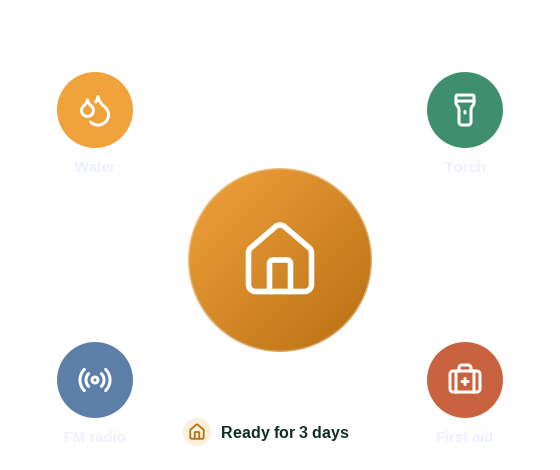
A home emergency kit is a small store of everyday essentials that lets your household cope for 3 days if the power, water or shops are disrupted. This checklist follows the UK government's Be Ready list item by item, with what to look for when you buy each one.
As an Amazon Associate we earn from qualifying purchases. Links marked ↗ go to Amazon UK searches; buying through them costs you nothing extra. How this site is funded.
Home Emergency Kit is an independent guide. It is not affiliated with, or endorsed by, the UK government or the Be Ready campaign.
The government's advice is simple: the Be Ready campaign says “being ready for 3 days helps you manage while support reaches those most in need”. You don't need to buy everything at once, and you probably have some of it already. Work down the list, tick what you have, and add the rest during your normal shopping.
Every item below is on the official checklist. Under each one we've added an independent note on what to look for if you need to buy it. The links go to Amazon UK search results rather than a single product, so you can compare options yourself.
The 3-day checklist, item by item
Print this checklist Ticks are only kept on this screen; nothing is saved or sent anywhere.
Water
Bottled water for 3 days
“3 litres per person per day for drinking. More would be needed for other tasks such as cooking and washing.”
Be Ready checklist, October 2026
What to look for: Sealed bottles you can lift easily: 2-litre bottles or 5-litre bottles with a handle are simple to store and carry. Check the best-before date and put it in your diary. A few large refillable water containers are useful for washing water.
“Food with a long shelf life that doesn't need refrigeration or cooking e.g. tinned meat, fish or vegetables, dried fruit and nuts. It's best to buy food you'd usually eat.”
Be Ready checklist, October 2026
What to look for: Tins with ring-pull lids (so you don't need a tin opener), plus a manual tin opener as a backup. Pick foods your household already eats, then rotate them into everyday meals before they go out of date.
“Hand sanitiser, wet wipes, hygiene and bathroom products.”
Be Ready checklist, October 2026
What to look for: Alcohol-based hand sanitiser, a large pack of wet wipes, toilet roll and any sanitary products your household uses. Bin bags are handy too.
What to look for: An LED torch or head torch that takes common AA or AAA batteries, plus a sealed pack of spare batteries. A wind-up or rechargeable torch avoids flat batteries; a head torch keeps your hands free.
“Homes can become cold very quickly when the heating goes off.”
Be Ready checklist, October 2026
What to look for: Warm blankets or fleece throws, a sleeping bag for each person (check its comfort temperature rating), hats and thermal layers. Foil emergency blankets are light extras, not a replacement.
“For updates during outages, write down frequencies of any national or local radio stations you use for news.”
Be Ready checklist, October 2026
What to look for: A radio with FM (DAB as a bonus) that runs on batteries, a hand crank or both. Many wind-up radios also have a torch and a USB output to top up a phone.
What to look for: A power bank of at least 10,000 mAh with the right cables for your phones. Charge it fully, then top it up when you check the kit. Check any medical device's manual before charging it from a power bank.
“In case electronic payments or ATMs are disrupted. The amount of cash you should keep depends on your family's specific needs for essentials.”
Be Ready checklist, October 2026
What to look for: Small notes and coins in a zipped pouch or cash tin kept with the kit. There is nothing to buy here beyond somewhere safe to keep it.
“Have printed copies of important documents such as passports, birth certificates, insurance policy details and instructions for any medical equipment you rely on.”
Be Ready checklist, October 2026
What to look for: A waterproof document wallet or zip folder keeps copies dry and together, so you can pick them up in one go.
“Write down contact details of who you'd need to contact in an emergency (including anyone who might need checking on) and a list of any regular medication and doses.”
Be Ready checklist, October 2026
What to look for: A pen and a small notebook in the kit. Write numbers on paper: a flat phone can't show you its contacts.
“Including items such as waterproof plasters, bandages, a thermometer, antiseptic, eyewash solution, sterile dressings and gloves, medical tape for dressings, and tweezers.”
Be Ready checklist, October 2026
What to look for: A home first aid kit that lists its contents, then add anything the Be Ready list names that it lacks (a thermometer, eyewash and tweezers are often missing). Check it against the list above.
“Always leave enough time to request repeat prescriptions so you have less chance of running out in an emergency. It's important to request prescriptions up to 5 working days before you need your medicine.”
Be Ready checklist, October 2026
What to look for: This one comes from your GP and pharmacy, not a shop. A labelled pill organiser or pouch helps keep doses and the medication list together.
“Ready-made or 'ready-to-feed' formula is best, as you may not be able to boil water to make up powdered formula safely.”
Be Ready checklist, October 2026
What to look for: Ready-to-feed liquid formula of the type your baby already has (check with your health visitor before changing), plus nappies and wipes. Check use-by dates when you check the kit.
Keep the kit together in one place everyone in the house knows about, such as a lidded plastic crate in a hall cupboard or under the stairs. A few practical rules of thumb:
Choose somewhere you can reach in the dark, so not the back of the loft.
Keep paper copies of documents in resealable, watertight plastic bags; the Be Ready flooding advice suggests this to protect them from water damage.
Put the torch and radio on top, where you can find them first.
Keep a smaller set of essentials in a bag you could pick up and leave with. That's your emergency grab bag.
Be Ready asks you to “set a reminder every six months to check expiry dates and swap out items that need replacing, or update your kit if your household's needs have changed”. An easy way to remember is to check it when the clocks change in spring and autumn. Each time:
Eat the food that's closest to its date and replace it, so nothing in the kit goes to waste.
Check the dates on bottled water, formula, medicines and first aid items.
Recharge the power bank and test the torch and radio.
Update the phone numbers and medication list, and add anything a new baby, pet or relative needs.
Extra items some households need
The checklist covers the basics. Think about what the people in your home rely on day to day. Ready Scotland's kit list adds things such as spare glasses or contact lenses, spare hearing aid batteries, a spare walking stick or mobility aid, spare keys, a whistle, face masks, and supplies or documents for assistance animals. Be Ready has a separate page of advice for disabled people and carers.
If anyone relies on equipment that needs electricity, sign up to the Priority Services Register so your electricity, gas and water companies know you may need extra help.
The parts that cost nothing
Several of the most useful steps are free and take a few minutes:
Write down important numbers on paper, including 105 to report a power cut in England, Scotland and Wales (03457 643643 in Northern Ireland), as Be Ready suggests.
Note the frequencies of the radio stations you use for news.
Print or photocopy key documents and keep them with the kit.
Agree a meeting place with your household in case you can't get home or contact each other.
Swap numbers with a neighbour, and agree who checks on anyone living alone.
Be Ready also notes that if you have spare items, you could donate them to people who can't easily prepare, or help someone by printing their documents.
Living in Scotland, Wales or Northern Ireland
The Be Ready checklist is published by the UK government. Scotland has its own campaign, Ready Scotland, with a very similar kit list. In Northern Ireland, see nidirect's Be ready for emergencies page. The power cut number differs too: 105 works in England, Scotland and Wales, while Northern Ireland uses 03457 643643. The Priority Services Register covers England, Scotland and Wales; Northern Ireland has customer care registers run by NIE Networks and NI Water.
The UK government's Be Ready checklist asks for 3 days of bottled water (3 litres per person per day for drinking) and non-perishable food, hand sanitiser, wipes and bathroom products, a torch with spare batteries, blankets and warm clothing, an FM radio (battery or wind-up), a charged power bank, cash and cards, copies of ID and documents, important phone numbers, a first aid kit, essential medication, and baby and pet supplies if you need them.
How much water should I keep in an emergency kit?
Be Ready says 3 litres per person per day for drinking, so 9 litres per person for 3 days. You'll need more for cooking and washing. Our emergency supplies calculator works out the total for your household.
Why does the checklist say 3 days?
Be Ready explains that being ready for 3 days helps you manage while support reaches those most in need. It is a starting point, not a limit.
Do I have to buy everything at once?
No. The official advice is to build your kit gradually: check your cupboards first, then pick up missing items on your regular shopping trips to spread the cost.
How often should I check my emergency kit?
Every six months. Check expiry dates, replace anything used or out of date, recharge the power bank and update the kit if your household has changed.
Is this the official government checklist?
No. Home Emergency Kit is an independent guide and is not affiliated with the UK government or the Be Ready campaign. We follow the official Be Ready checklist and link to it so you can check it yourself.
Why a torch rather than candles?
The Be Ready checklist says torches are safer than candles. Keep spare batteries, or choose a wind-up or rechargeable torch.
What food is best for an emergency kit?
Food with a long shelf life that doesn't need a fridge or cooking, such as tinned meat, fish or vegetables, dried fruit and nuts. Be Ready says it's best to buy food you'd usually eat.
Official pages last checked on 23 November 2026. If anything here differs from the official advice, follow the official advice, and please tell us so we can fix it.