As an Amazon Associate we earn from qualifying purchases. Links marked ↗ go to Amazon UK searches; buying through them costs you nothing extra. How this site is funded.
Home Emergency Kit is an independent guide. It is not affiliated with, or endorsed by, the UK government or the Be Ready campaign.
Run by IIB Trading Ltd · [email protected]
The checklist is part of the government's Be Ready campaign, and you can download it as a two-page PDF dated October 2026. It sits alongside a printable household emergency plan. This page is our independent explanation of it. We quote the official wording where it matters and link to the source, so you can always check the original.
What the Be Ready checklist is for
The list covers the supplies a household would want if an emergency, such as a long power cut, flooding or severe weather, disrupted normal life for a few days. Its aim is modest. In the campaign's words, being ready for 3 days “helps you manage while support reaches those most in need”. Fewer people needing urgent help means help gets to the people who need it most.
It's guidance, not a rule. The campaign accepts that “not everyone will be able to take all the actions” and suggests you take the steps that work for you. And if anyone is in immediate danger, the first step is always to call 999.
The five starting steps
Before the list itself, the checklist gives five steps for getting started. In plain terms:
- Look in your cupboards first. Torches, tins, blankets and a first aid kit are often already in the house.
- Plan for the people (and animals) you live with. Medical supplies, baby formula and pet food are easy to forget.
- Spread the cost. Add one or two missing items to your normal shop rather than buying it all in one go.
- Check twice a year. A six-monthly reminder to look at dates and swap things out.
- Talk to your neighbours. Swap contact details and agree what you could share during an outage.
The nine categories, and why each one is there
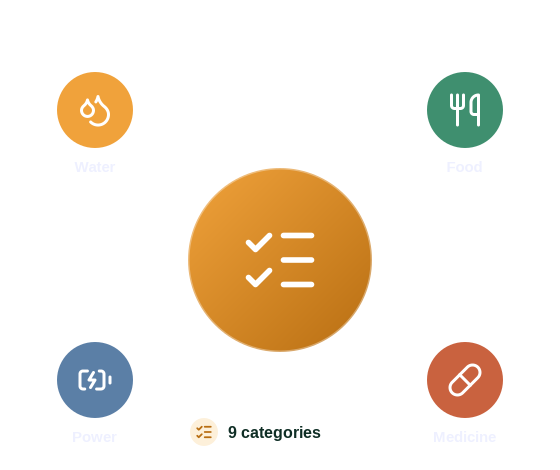
The checklist groups its items into nine categories. The third column is our summary of the reason the official checklist gives, or the obvious purpose where it gives none.
| Category | What it asks for | What it's for |
|---|---|---|
| Water | Bottled water for 3 days | Drinking water: 3 litres per person per day, with more needed for cooking and washing. |
| Food | Non-perishable food for 3 days | Long-life food that needs no fridge and no cooking, ideally things you normally eat. |
| Hygiene | Hand sanitiser, wet wipes, bathroom products | Keeping clean when washing water is limited. |
| Light and warmth | Torch and spare batteries; blankets, sleeping bags, warm clothes | Homes cool down fast once the heating stops, and torches are safer than candles. |
| Communication and information | FM radio (battery or wind-up); charged power bank | News and instructions during an outage; charging phones or compatible medical devices. |
| Money and documents | Cash and cards; copies of ID and documents; important numbers | Card machines and cash machines can stop working; copies help if originals are lost or you need to leave. |
| Medical and health | First aid kit; essential medication and supplies | Treating minor injuries yourself and not running out of regular medicines. |
| Baby products | Ready-to-feed formula; nappies and wipes | You may not be able to boil water to make up powdered formula safely. |
| Pet products | Pet food and bottled water | Animals need their own supply too. |
Our home page lists every item with a tick box and notes on what to look for if you need to buy it.
Six details that are easy to miss
- The 3 litres is for drinking only. The checklist says more is needed for cooking and washing, so plan above the minimum if you can. Our supplies calculator keeps the two separate.
- Cash and cards. The advice is a mix of coins and notes as well as cards, in case electronic payments or cash machines are disrupted. How much depends on what your household would need for essentials.
- Write down radio frequencies. When the power and mobile data are down, knowing where your local station sits on the FM dial saves fumbling in the dark.
- Copies, not originals. Printed copies of passports, birth certificates, insurance details and instructions for any medical equipment you rely on.
- Medication needs a head start. The checklist says to request repeat prescriptions up to 5 working days before you need them, so you're less likely to run out.
- Ready-to-feed formula. Powdered formula needs freshly boiled water, which you may not have. The NHS guide to making up formula explains why the water must be at least 70C.
What the checklist doesn't ask for
It's just as telling to look at what isn't there. The official list does not include generators, weeks of stockpiled food, specialist survival rations, water filters or camping stoves. It asks for ordinary things, mostly available in a supermarket, in amounts that last 3 days. If you've seen online lists that run to hundreds of items, our guide to a realistic UK survival kit goes through what you can safely skip.
The rest of the Be Ready advice
Supplies are only one part. The same Be Ready page also suggests you:
- fill in the household emergency plan and keep it with your important documents;
- agree a meeting point and a backup plan for anyone who lives alone;
- add emergency contacts or medical information to your phone's lock screen (often called ICE or Medical ID);
- learn some basic first aid, for example from St John Ambulance;
- test smoke alarms at least once a month and know how to turn off your gas, electricity and water;
- check whether you can join the Priority Services Register;
- keep a few winter essentials in the car boot, such as a torch, a phone charger, warm clothes, blankets and a shovel.
If you live in Scotland or Northern Ireland
Ready Scotland publishes its own kit list. It closely matches Be Ready and adds a few items: face masks, a whistle, spare keys, spare glasses, spare hearing aid batteries, pencil and paper, and any mobility aids you need. Its emergency plan page lists useful Scottish numbers, including NHS 24 on 111, Scottish Water on 0800 077 8778 and SEPA Floodline on 0345 988 1188. In Northern Ireland, nidirect carries the Be ready for emergencies campaign, and power cuts are reported on 03457 643643.
A simple order to work through it
This order is our suggestion, not part of the official checklist. It puts the free jobs first and spreads the spending over a month:
Write down numbers, copy documents, list medicines and doses, note radio frequencies, check what's in the cupboards.
Add bottled water and a few no-cook tins to the normal shop.
Torch, batteries, FM radio and a power bank, charged and labelled.
Top up the first aid kit, order repeat prescriptions in good time, gather blankets and warm layers.
Search Amazon UK: Wind-up FM radios Power banks First aid kits
Questions people ask
Who publishes the Be Ready checklist?
The UK government publishes it as part of the Be Ready campaign at beready.campaign.gov.uk. This site is an independent guide to it and is not connected to the government.
Where can I download the Be Ready checklist?
From the official Be Ready page, which links to a two-page PDF checklist (October 2026) and a printable household emergency plan.
What does 'be ready for 3 days' mean?
It means having enough water, food and essentials at home for your household to manage for 3 days without outside help, while support goes to those who need it most.
Do I have to follow the whole checklist?
No. The campaign recognises that not everyone can take every step and suggests building up gradually and doing what works for your household.
Why does the checklist recommend ready-to-feed baby formula?
Because in an emergency you may not be able to boil water to make up powdered formula safely. Ready-to-feed formula needs no water.
Does the Be Ready checklist apply in Scotland and Northern Ireland?
The advice is useful anywhere in the UK, but Scotland has its own Ready Scotland campaign and Northern Ireland uses nidirect. Their lists are very similar.
How is the checklist on this site different from the official one?
The items are the same. We add notes on what to look for if you need to buy something, plus links to Amazon UK searches. We earn a small commission if you buy through them.
Related guides
Sources
- Be Ready: Be ready for emergencies (UK government campaign)
- Be Ready checklist (PDF, October 2026)
- Be Ready household emergency plan (PDF)
- NHS: How to make up baby formula
- St John Ambulance: First aid advice
- Ready Scotland: Make an emergency kit
- Ready Scotland: Make an emergency plan for your home
- nidirect: Be ready for emergencies (Northern Ireland)
Official pages last checked on 23 November 2026. If anything here differs from the official advice, follow the official advice, and please tell us so we can fix it.